
By Jennet Parkar October 4, 2026
You can sometimes switch payment processors with merchant cash advance obligations still outstanding, but the repayment structure and your signed agreement control the answer. If card settlement is being split to the MCA provider, changing or adding processors without required written consent can interrupt contracted remittances and create a potential default issue.
A merchant account approval from a new processor does not answer the financing question. The processor may be perfectly willing to open your new MID while your MCA agreement separately restricts where card volume, settlement proceeds, or purchased receivables can go.
That distinction is the key to determining whether you can safely switch payment processors with merchant cash advance obligations still active.
Can You Switch Payment Processor With Merchant Cash Advance Debt Still Outstanding?
You may be able to switch payment processor with merchant cash advance debt or purchased-receivables obligations still outstanding. There is not one standard MCA contract, and the primary sources reviewed do not establish a universal rule that every merchant receiving an MCA must remain with one processor until the transaction is completed.
What matters is the actual repayment plumbing and contract language. Review the MCA agreement, amendments, ACH authorization, processor addendum, lockbox agreement, security agreement, guaranty, reconciliation provision, notice clause, and any separate settlement instructions.
There is also a major difference between:
- obtaining approval for another merchant account;
- adding a second MID;
- sending a small amount of volume to the second processor;
- moving all card volume;
- changing the bank account receiving settlement; and
- terminating the original processor.
A new processor can technically process your payments without resolving whether the move complies with your existing financing contract.
Quick Answer: What Controls the Switch?
| Question | Why It Matters |
| How is the MCA being collected? | Processor split, ACH, and lockbox arrangements create different dependencies. |
| Does the agreement designate an approved processor? | A change may require prior written consent. |
| Does it prohibit an additional processor? | Keeping the old MID open does not necessarily make the new MID permissible. |
| Where must settlement be deposited? | Processor choice and settlement-account restrictions can be separate obligations. |
| What happens if remittance stops? | Default and remedy provisions vary materially by agreement. |
A February 11, 2026 MCA agreement filed with the SEC is a useful real-world example. Although collections under that agreement occur through ACH from an approved deposit account, the contract separately states that the merchant will not change its processor, add terminals, or change its financial institution/account without the funder’s prior written consent.
That contract does not establish a rule applicable to every MCA. It demonstrates why merchants should not assume that an ACH-based collection method eliminates a processor covenant.
First Identify How Your MCA Is Being Repaid

Before you switch payment processor with merchant cash advance obligations outstanding, trace one dollar of customer revenue from the point of sale to the MCA provider.
Current industry filings confirm that ACH debit and credit-card split processing remain collection methods used by MCA businesses. A 2026 SEC filing by an MCA business states that payments are typically collected through ACH debits and, in some cases, through credit-card split processing.
Actual merchant agreements also document three distinct architectures: direct debit, payment-card split, and lockbox arrangements. A 2024 SEC-filed agreement expressly describes all three and requires written agreement to change the selected delivery method.
| Repayment Structure | How Money Moves | Processor Dependency | Main Switching Risk | What to Confirm |
| Processor split | Processor sends an agreed portion of settlement to funder | Usually high | New MID may bypass the existing split | Approved processor, split percentage, consent |
| Lockbox / controlled account | Receipts settle to a designated account before distribution | Medium to high | New processor may send settlement somewhere else | Required account, control terms, routing |
| ACH debit | Funder debits an operating or designated bank account | Often lower operationally | Contract may still prohibit processor or account changes | Processor covenant, ACH terms, notice, account restrictions |
1. Processor Split or Split-Funding MCA
A processor split creates the clearest direct dependency between payment processing and MCA collection. One SEC-filed agreement describing a payment-card split method requires card transactions to flow through an approved processor and addresses consent before switching or adding another processor. That is an example of actual contract drafting, not a rule that applies to every MCA.
Under a typical contractual design, the payment processor sends the purchased percentage or other specified remittance to the MCA provider and sends the remaining settlement to the merchant. The exact implementation varies by agreement and processor.
A 2024 SEC-filed agreement provides a particularly clear example: under its Payment Card Split Method, the merchant must use one approved card processor, instruct that processor to remit the specified percentage to the purchaser, and obtain express written consent before switching processors or using an additional processor.
That is why the split funding MCA processor requirement needs to be read literally from your contract. The practical question is not simply, “Does my MCA use a holdback?” It is, “Does this specific agreement require sales to pass through an approved processor or processor configuration?”
A merchant cash advance processor split can also create a technical dependency. The replacement acquirer or processor must be capable of implementing whatever settlement instruction the funder has approved.
If you need to switch credit card processor during MCA repayment under this structure, do not move live volume first and attempt to repair the split afterward.
2. Lockbox or Controlled Bank Account
A lockbox changes the center of gravity from the merchant account to the deposit destination.
Under one SEC-filed agreement, the merchant’s approved processor and invoiced customers may be directed to deposit receipts into a specified lockbox account. The purchaser then collects the contractual delivery amount through that arrangement.
This means MCA lockbox account rules are not a single body of special “MCA law.” The operative requirements normally come from the MCA contract, lockbox agreement, bank documentation, security agreement, and applicable commercial law.
The distinction matters when a merchant wants to change both its processor and bank at once. If Processor B can continue depositing into the existing approved lockbox, the operational problem may be different from a migration that simultaneously replaces the processor, settlement account, and repayment route.
Do not confuse a lockbox with a UCC filing either.
Using New York as a concrete legal example, current UCC § 9-104 defines when a secured party has “control” of a deposit account. Control can arise through specified arrangements involving the bank and secured party; filing a UCC-1 by itself is not the same as satisfying those deposit-account-control requirements.
New York UCC § 9-312 also provides that, subject to its stated exceptions for proceeds, a security interest in a deposit account may be perfected only by control.
Merchants reviewing MCA lockbox account rules should therefore distinguish four different things: a contractual promise to use a bank account, a lockbox arrangement, a security interest, and actual Article 9 control of a deposit account.
3. Fixed ACH or Daily/Weekly Bank Debit
ACH collection does not necessarily mean the merchant is free to change processors. A February 2026 MCA agreement filed with the SEC uses ACH debits from the merchant’s designated account while separately requiring prior written consent before specified processor, terminal, financial-institution, or account changes.
Under an ACH collection model, the funding provider debits an approved business account rather than receiving its share directly from each card settlement.
From a purely operational standpoint, that can make it easier to switch payment processor with merchant cash advance repayment still running because the new card processor may not be the mechanism that delivers the funder’s remittance.
But “easier” does not mean “automatically permitted.”
The February 2026 SEC-filed agreement discussed above is strong evidence of that distinction: it provides for ACH debits but separately contains a processor-change covenant.
Nacha’s current ACH materials also reinforce that business ACH transactions rest on an agreement between the business parties. For corporate CCD/CTX transfers, Nacha identifies an agreement as the authorization basis; Nacha’s guide states that business parties must have an agreement, although the Rules do not dictate all of its substantive terms.
So an MCA ACH repayment conversion or existing ACH arrangement must be analyzed together with the funding contract—not as a substitute for reading it.
Why Split-Funded MCA Agreements May Restrict Processor Changes
The commercial reason is straightforward: if processor settlement is the agreed collection path for purchased receipts, changing that path can prevent the expected remittance from reaching the provider.
An agreement may regulate:
- changing the approved processor;
- adding another processor;
- adding terminals or MIDs;
- moving ecommerce transactions;
- diverting receivables;
- changing settlement instructions;
- opening or changing the settlement bank account; or
- interfering with the agreed collection method.
Processor restrictions should be read from the actual funding agreement rather than assumed from general MCA practice. For example, one SEC-filed merchant cash advance agreement expressly addresses processor changes and prior written consent, showing why ACH collection and processor restrictions must be analyzed as separate contractual issues.
A processor consent clause merchant cash advance provision can therefore matter even where the document does not literally say “you may never switch processors.”
For example, the 2026 SEC-filed agreement prohibits specified processor/account changes without prior written consent. A different SEC-filed agreement covering a payment-card split specifically requires express written consent before using another payment processor.
Those are examples of real contractual drafting—not universal statutory requirements.
The MCA payment processor restriction that matters to you is the one in your operative documents. Search not only the main MCA contract but every incorporated addendum.
Likewise, the split funding MCA processor requirement may appear under headings such as Approved Processor, Remittance, Delivery of Purchased Receipts, Covenants, Electronic Check Processing, Additional Processor, or Event of Default.
Does Changing Processor Mid-MCA Automatically Mean Breach?

No. A change processor mid MCA breach analysis is contract- and fact-specific.
Merely applying for a new account is not necessarily equivalent to diverting receivables. Processing a test transaction is not necessarily equivalent to transferring all sales. And an accidental operational interruption is factually different from intentionally routing receipts away from the agreed collection path.
Still, if you switch payment processor with merchant cash advance restrictions that expressly require prior consent, moving production volume before approval can create a serious contract dispute.
Look for these defined terms:
| Contract Term | What You Need to Determine |
| Approved Processor | Is one processor specifically designated? |
| Additional Processor | Is a second processor restricted? |
| Receipts / Receivables | Which revenue streams fall within the agreement? |
| Diversion | What conduct is prohibited? |
| Designated Account | Where must settlement land? |
| ACH Authorization | What account and debit authority apply? |
| Reconciliation | Can remittances adjust with actual receipts? |
| Event of Default | Which conduct actually triggers contractual remedies? |
| Notice | How and when must consent requests be delivered? |
| Guaranty | What obligations does the owner actually guarantee? |
| Security Interest | What collateral is covered? |
| Governing Law | Which state’s law applies? |
This is also why an MCA should not automatically be characterized as either a conventional loan or an unquestionably enforceable receivables purchase merely from its title.
Current New York appellate authority continues to examine the real economics and contractual terms. In Blade Funding, LLC v Build Retail, Inc., decided in September 2026, the Second Department evaluated whether repayment was absolute or contingent by looking at reconciliation, whether the term was finite, and recourse in bankruptcy.
Earlier 2026 decisions such as Diesel Funding, LLC v Build Retail, Inc. and Spin Capital, LLC v Bridgelink Engineering, LLC applied similar analysis.
The practical point is simple: the label on the first page does not eliminate the need to review governing law and the actual contractual mechanics.
How Can an MCA Provider Detect a Processor Change?
Usually, the most defensible answer is: through observable changes in the payment flow and information rights created by the contract.
Possible indicators include:
- expected processor-split remittances stopping;
- a sudden decrease in settlement to the designated account;
- historical processing patterns no longer matching remittances;
- processor reports ceasing;
- new deposits appearing through an unexpected route; or
- information supplied under contractual verification provisions.
The 2026 SEC-filed agreement authorizes the merchant’s bank or credit union to provide banking and/or card-processing history and allows the funder to request processing statements for reconciliation.
That supports saying a funder may have contractual access to specified information.
It does not support saying MCA companies have a universal database showing every MID a merchant opens. Avoid that claim.
What Can Happen If Contracted MCA Remittances Stop?
An MCA default after processor change is possible where the actual agreement treats the conduct as a default or where the processor change intentionally prevents contractual collections. It is not an automatic result of every processor migration.
The February 2026 SEC-filed contract illustrates the distinction. Its stated events of default include intentionally preventing the funder from collecting according to the agreement.
The same contract provides specified remedies after an event of default, including making the uncollected purchased amount and contractual fees due, enforcing a security interest, litigating or arbitrating, and directing processors or account debtors under the contractual provisions.
Again, that tells us what that contract claims to permit. It does not prove that identical remedies exist in every MCA or that every clause will be enforced exactly as written in every jurisdiction.
Three separate questions should always be asked:
- What does the contract say is an Event of Default?
- What remedy does the funder claim the contract provides?
- Is that provision enforceable under the governing law and facts?
Personal guaranty exposure is not automatic
Changing processors does not automatically “trigger” every personal guaranty.
A guaranty may cover broad payment obligations, performance covenants, specified bad acts, diversion, fraud, or only defined defaults. Its scope must be read from the signed guaranty itself.
The importance of the contract-specific analysis is illustrated by True Business Funding, LLC v Guerrero A Construction Corp., where the New York Appellate Division concluded that bankruptcy did not trigger the personal guaranty under the agreement at issue because the underlying contract treated bankruptcy differently.
Do not assume one owner’s guaranty behaves like another.
A UCC-1 is not automatic bank-account ownership
Likewise, a funder does not gain unrestricted access to a merchant’s bank account simply because a UCC-1 was filed.
Under current New York UCC § 9-607, a secured party may have specified collection and enforcement rights if the parties agreed or after default, including notifying account debtors and, in defined circumstances, dealing with a deposit account over which it has control. Those rights depend on the statute, security interest, contractual arrangements, collateral, perfection, control, and facts.
That is materially more precise than saying “the UCC lets the funder seize your bank account.”
The Safest Route: Get MCA Funder Consent to Switch Processors Before Cutover
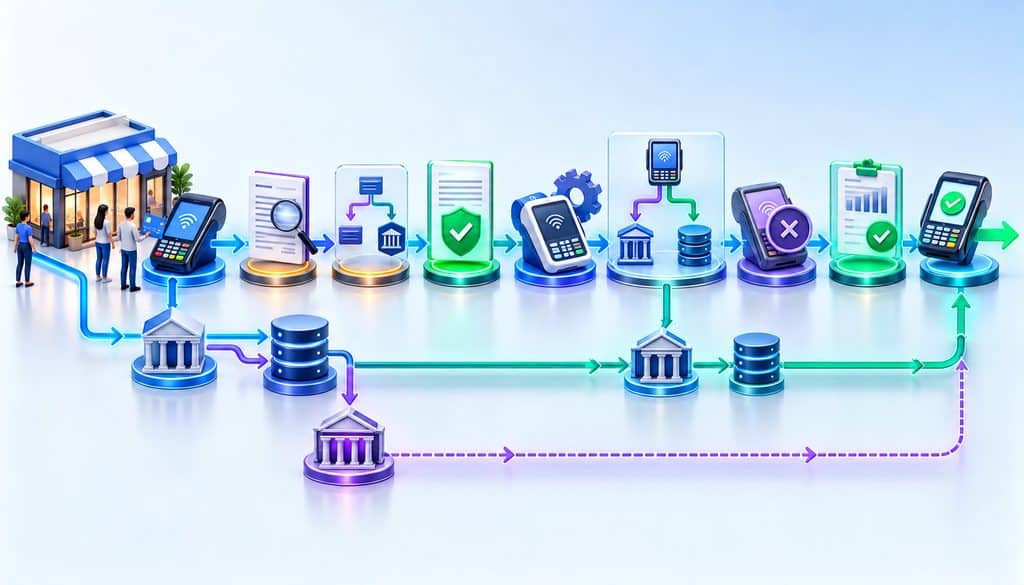
If you need to switch payment processor with merchant cash advance repayment still active, coordination before cutover is substantially safer than moving volume first.
The following workflow is designed to preserve the existing payment path until the replacement arrangement has been approved.
- Map the current repayment structure: Confirm whether collection is processor split, ACH, lockbox, or a hybrid.
- Pull the full contract file: Include the funding agreement, amendments, ACH authorization, processor agreement, guaranty, security agreement, and lockbox documents.
- Identify processor and diversion provisions: Search both defined terms and ordinary wording.
- Identify the notice procedure: Confirm required email, address, notice period, and authorized recipient.
- Request a current payoff figure if payoff is an alternative.
- Complete underwriting with the replacement processor without moving production volume.
- Confirm technical compatibility: Determine whether it can support the required bank destination, split instructions, reporting, gateway, recurring billing, refunds, and chargebacks.
- Request written MCA funder consent to switch processors.
- Document the effective date and approved repayment method.
- Re-paper the split, lockbox routing, or ACH authorization if required.
- Keep the original processor running through final batches and pending settlements where permitted.
- Verify the first repayment under the new arrangement.
- Reconcile old and new settlement records.
- Archive the approval and all related instructions.
Verbal permission from a salesperson is weaker operational evidence than written authorization from the contractually appropriate funder or servicer.
A proper processor consent clause merchant cash advance request should state the proposed processor, MID or account structure if available, settlement bank, effective date, reason for the change, and proposed method for keeping remittances uninterrupted.
Three Ways an Approved Processor Migration Can Be Structured
Option 1: Move the Processor Split to the New Processor
The cleanest solution for some split-funded arrangements is to replicate the approved remittance path with the replacement processor.
The new acquirer must actually support the necessary implementation. Not all processors permit third-party split settlement or outside directions over settlement funds.
This is where a merchant cash advance processor split becomes both a contract question and a technical payments question.
Ask who at the replacement processor must approve the arrangement, whether settlement can be divided, whether reports can be supplied to the funder, and how refunds or chargebacks affect the split.
Visa’s April 2026 Core Rules require an acquirer to maintain a Merchant Agreement with its merchants and impose defined Merchant Agreement requirements. Visa also directs merchants to their acceptance agreement with the acquirer for additional requirements.
So the replacement processing agreement deserves the same attention as the funding agreement.
Option 2: Convert the Processor Split to ACH
An MCA ACH repayment conversion can reduce dependence on the payment processor, but it should be approved before implementation when the existing agreement requires another collection method.
Document:
- the approved bank account;
- debit frequency;
- amount or percentage methodology;
- start date;
- reconciliation process;
- treatment of insufficient funds or returns; and
- whether the processor covenant remains in effect.
The last question is critical. Changing repayment to ACH does not necessarily cancel an unrelated MCA payment processor restriction.
Nacha’s 2026 corporate-user materials confirm that the 2026 Nacha Operating Rules remain the governing network framework for corporate ACH users.
Option 3: Pay the MCA Off Before Moving Processing
A merchant cash advance payoff before processor switch can eliminate a processor-linked funding dependency once the transaction is properly satisfied and any applicable restrictions or collateral releases are addressed.
But do not use a dashboard number as a substitute for a written payoff quote.
Confirm:
- payoff amount;
- good-through date;
- pending ACH or split remittances;
- credits already in transit;
- any contractually authorized payoff adjustment;
- early-payoff provisions;
- reconciliation;
- release requirements; and
- treatment of any UCC filing.
If another financing facility would be used to clear the MCA before the processor migration, compare the existing payoff amount with the full cost and term of the replacement debt. The decision should account for the tradeoffs involved in refinancing short-term debt with longer-term financing rather than comparing monthly payments alone.
How to Time the Processor Migration Without Breaking Repayment
When you switch payment processors with merchant cash advance arrangements in place, the cutover date should be treated as a financial reconciliation event, not merely a terminal-installation date.
Before cutover
Obtain written approval and finish new-processor underwriting. Configure the approved split, ACH, or settlement account before production sales move.
Identify unsettled batches, pending authorizations, open refunds, recurring billing profiles, gateway tokens, reserves, and upcoming chargebacks.
During cutover
Do not redirect sales before the approved effective date.
Where the agreement allows an overlap, keep the incumbent processor available long enough to settle transactions that belong there. Document which system owns new transactions and which processor remains responsible for legacy adjustments.
This protects the split-funded advance repayment from being unintentionally interrupted simply because operational teams changed terminals before finance teams changed settlement instructions.
After cutover
Reconcile the old processor’s final batches to bank deposits and funder remittances. Then confirm the first new remittance separately.
A successful first card deposit is not enough. The first funder remittance must also arrive through the approved pathway.
For a split-funded advance repayment, compare at minimum the gross processing amount, processor deductions, amount sent to the MCA provider, amount deposited to the merchant, refunds, and chargebacks.
Should You Keep Two Processor Accounts During the Transition?
You might, but adding a second account can be contractually significant.
A dual-processor period can make terminal replacement, gateway migration, recurring billing, final batches, and troubleshooting easier. It can also create exactly the problem the funding contract was designed to prevent.
Before you switch credit card processors during MCA obligations, determine whether the agreement restricts both replacement and addition.
The 2024 SEC-filed split agreement expressly prohibits both switching to a different processor and using an additional processor without written consent.
That means leaving Processor A open does not necessarily cure the change processor mid MCA breach concern if Processor B begins receiving sales that the contract required to flow elsewhere.
If the incumbent processor freezes or terminates the merchant account, first document the reason for the interruption, the status of unsettled funds, and any remaining batches.
A structured merchant-account freeze or termination response can help separate the processor problem from the MCA issue, but a replacement MID should still be coordinated with the funder when the financing agreement restricts processor changes or revenue diversion.
When Paying Off the MCA First May Be Cheaper Than Running Two Processing Relationships
A merchant cash advance payoff before processor switch is primarily an economics and liquidity decision after the contractual issues are understood.
Compare the incremental cost of keeping both systems alive with the incremental cost and cash requirement of payoff.
Hypothetical example
Assume the following fictional figures:
| Item | Amount |
| Written MCA payoff quote | $40,000 |
| Remaining expected contractual collections if unchanged | $41,500 |
| Potential payoff reduction | $1,500 |
| Three months of duplicate processor/gateway costs | $1,200 |
| Extra reconciliation/implementation labor | $900 |
| New processor savings over three months | $1,950 |
| New-system implementation cost | $1,200 |
The temporary dual-processing burden is:
$1,200 + $900 − $1,950 = $150 net transition cost
The gross short-term benefit of immediate payoff in this fictional case might be:
$1,500 payoff reduction + $1,950 processing savings − $1,200 implementation = $2,250
But that calculation does not value the cost of using $40,000 of cash immediately. If that liquidity is important to payroll, inventory, taxes, or operations, maintaining the MCA may still make more economic sense.
The example therefore does not force a payoff recommendation.
What to Ask the New Processor Before You Sign
Before you switch payment processor with merchant cash advance restrictions still active, ask the replacement provider questions that connect merchant-services underwriting to the funding agreement.
- Can your platform support third-party split settlement?
- Can a defined portion of settlement be remitted to an MCA provider?
- Can all settlement be sent to the existing approved or lockbox account?
- Who internally approves an outside split instruction?
- Does your merchant agreement prohibit an assignment or third-party direction affecting settlement?
- Could a reserve reduce funds expected by the MCA provider?
- What reporting can be supplied for reconciliation?
- Can legacy refunds still be issued after the old MID closes?
- How are chargebacks for pre-migration transactions funded?
- Will recurring-payment tokens migrate?
- Will the gateway change?
- Can we stage locations or channels separately?
- Does anything in your processing contract conflict with our existing funding covenant?
The final question is particularly important. A merchant should not solve one contractual conflict by signing a second incompatible contract.
Contract Clauses to Review Before You Switch
| Clause | Why It Matters | Red Flag | Action |
| Approved processor | Can tie card activity to one provider | Consent language | Request written approval |
| Additional processor | Can restrict a second MID | “Additional” or “other processor” wording | Approve overlap |
| Receivables/diversion | Controls where purchased receipts flow | Prohibition on diversion | Map every channel |
| Settlement account | Controls where processor funds deposit | One approved account | Preserve routing or re-paper |
| Lockbox | May require all receipts in designated account | Mandatory lockbox deposits | Test routing |
| ACH authorization | Governs account debits | Specific account or authorization | Amend properly |
| Reconciliation | Aligns collections to receipts where applicable | Strict documentation/process | Preserve records |
| Notice | Controls valid communications | Formal delivery procedure | Follow it exactly |
| Event of Default | Defines triggers | Processor/diversion trigger | Review before cutover |
| Default charges | Sets claimed contractual amounts | Automatic fee language | Review enforceability |
| Personal guaranty | May create owner exposure | Broad performance guaranty | Review separately |
| Security agreement | Defines collateral | Broad accounts/proceeds grant | Review Article 9 implications |
| UCC authorization | Permits financing statement filing | Broad filing authorization | Distinguish filing from control |
| Payoff | Governs early satisfaction | Special payoff process | Obtain written quote |
| Governing law | Determines applicable legal framework | Out-of-state law/forum | Obtain legal advice if material |
| Arbitration/forum | Determines dispute venue | Mandatory distant forum | Factor into risk |
If the agreement ties remittances to a percentage of actual receipts, review exactly how the reconciliation provision adjusts payments when actual revenue differs from the amount originally estimated. The request procedure, supporting records, timing, and adjustment method should be understood before the processor cutover changes the sales data used for that calculation.
Real-World Example: A Restaurant Wants a Better Processing Rate Mid-MCA
Hypothetical scenario: A restaurant has an active card-processing split. The funding agreement identifies an approved processor and directs part of settlement toward the purchased-receivables obligation.
A competing processor offers materially better merchant pricing.
Path A: The restaurant switches quietly
The owner activates the new account Friday night and routes most weekend volume through it.
The original processor now reports much less card activity. Its remittance to the MCA provider falls accordingly.
The provider observes that expected collections have dropped and reviews the processor, diversion, information, notice, and default provisions.
This can become an MCA default after processor change dispute if the facts fit the contract’s defined default provisions. The legal result should not be predicted without the actual agreement and applicable law.
Path B: The restaurant obtains consent first
The merchant sends the proposed processing agreement and settlement details to the funder.
The funder confirms whether the replacement processor can be approved. The merchant obtains written MCA funder consent to switch processors, and the parties document the revised collection method.
The restaurant schedules the last production day on the old platform, lets pending batches settle, activates the new MID on the approved effective date, verifies the first deposit, and separately verifies the first MCA remittance.
That process does not guarantee there can never be a dispute. It creates substantially better documentation of what everyone agreed should happen.
Common Mistakes That Create Avoidable Processor-Change Risk
A recurring change processor mid MCA breach problem often begins with an operational assumption rather than an intentional decision to stop paying.
Common mistakes include:
- Treating merchant services and MCA repayment as unrelated systems.
- Opening and using another MID before reading the agreement.
- Moving ecommerce volume while leaving only in-store volume on the approved processor.
- Replacing the processor and settlement bank simultaneously.
- Closing the original MID before all batches settle.
- Forgetting recurring payments and stored credentials.
- Ignoring legacy refunds and chargebacks.
- Assuming ACH repayment eliminates processor covenants.
- Relying solely on verbal approval.
- Treating a portal balance as the final payoff amount.
- Assuming a UCC-1 equals control of a bank account.
- Signing a new processing contract that conflicts with the old funding contract.
Documents to Collect Before Requesting Approval
Before seeking MCA funder consent to switch processors, assemble one migration file containing:
- executed MCA agreement;
- amendments;
- funding schedule;
- processor or split-funding addendum;
- ACH authorization;
- lockbox agreement;
- settlement-account instructions;
- security agreement;
- personal guaranty;
- current processor agreement;
- most recent processing statements;
- proposed replacement processing agreement;
- proposed pricing schedule;
- gateway contract;
- recurring-billing or token-migration plan;
- current settlement-account details;
- written payoff quote if payoff is being considered;
- written funder approval; and
- revised repayment instructions.
This prevents the processor sales team, merchant finance team, funder, gateway, and bank from working from different versions of the facts.
Frequently Asked Questions
Can I switch payment processors if I still owe an MCA?
Possibly. The answer depends on your repayment method and contract. If the MCA uses a processor split, the existing processor may be part of the actual collection mechanism.
ACH and lockbox arrangements create different dependencies. To switch payment processor with merchant cash advance obligations safely, review both the processor covenant and revenue-routing provisions before moving live volume.
Does every merchant cash advance require me to keep the same processor?
No universal requirement was identified in the primary sources reviewed. Actual contracts vary. Some SEC-filed agreements expressly require a single approved processor, while others use ACH, processor split, lockbox, or combinations of those mechanisms.
What is a split-funded MCA?
A split-funded arrangement uses payment-processing settlement as the collection channel for an agreed share of receipts. An actual SEC-filed agreement illustrates the model by requiring the approved processor to send the specified percentage to the purchaser.
Can an MCA funder tell if I change processors?
It may detect a change through interrupted remittances, changing settlement patterns, missing processor reports, or contractual information rights. That is different from claiming the provider has universal visibility into every processor or MID you open.
Is adding a second processor the same as replacing my processor?
Not necessarily operationally, but your agreement may regulate both. Some publicly filed contracts specifically prohibit using an additional processor without written consent.
Can I change split funding to ACH?
Potentially, but an MCA ACH repayment conversion should be documented and approved where your existing agreement requires a different method. The new ACH arrangement should state the account, frequency, amount or calculation method, start date, and reconciliation mechanics.
Will changing processors automatically trigger my personal guaranty?
No. The scope of the guaranty, the alleged default, and governing law matter. Current case law demonstrates why guaranty consequences cannot be separated from the underlying agreement’s treatment of the alleged default.
Should I pay the MCA off before changing processors?
Sometimes payoff produces the cleanest migration, but the decision should be based on a written payoff quote, remaining contractual collections, any early-payoff adjustment, liquidity cost, duplicate processing expenses, and anticipated savings—not the portal balance alone.
What happens to refunds and chargebacks after I switch?
Transactions processed on the old merchant account can continue creating adjustments after the sales migration. Confirm which processor will handle each legacy refund or chargeback and how those adjustments interact with the MCA’s revenue and reconciliation calculations.
Key Takeaway for Merchants Planning a Processor Change
The safest way to switch payment processor with merchant cash advance obligations still active is not to assume either that switching is prohibited or that processor choice is irrelevant.
Start with the repayment map.
A processor-split arrangement has the clearest direct processor dependency. A lockbox structure may be more dependent on the settlement destination. An ACH arrangement can reduce processor dependency operationally, but real 2026 contract evidence shows it does not necessarily eliminate an independent processor covenant.